










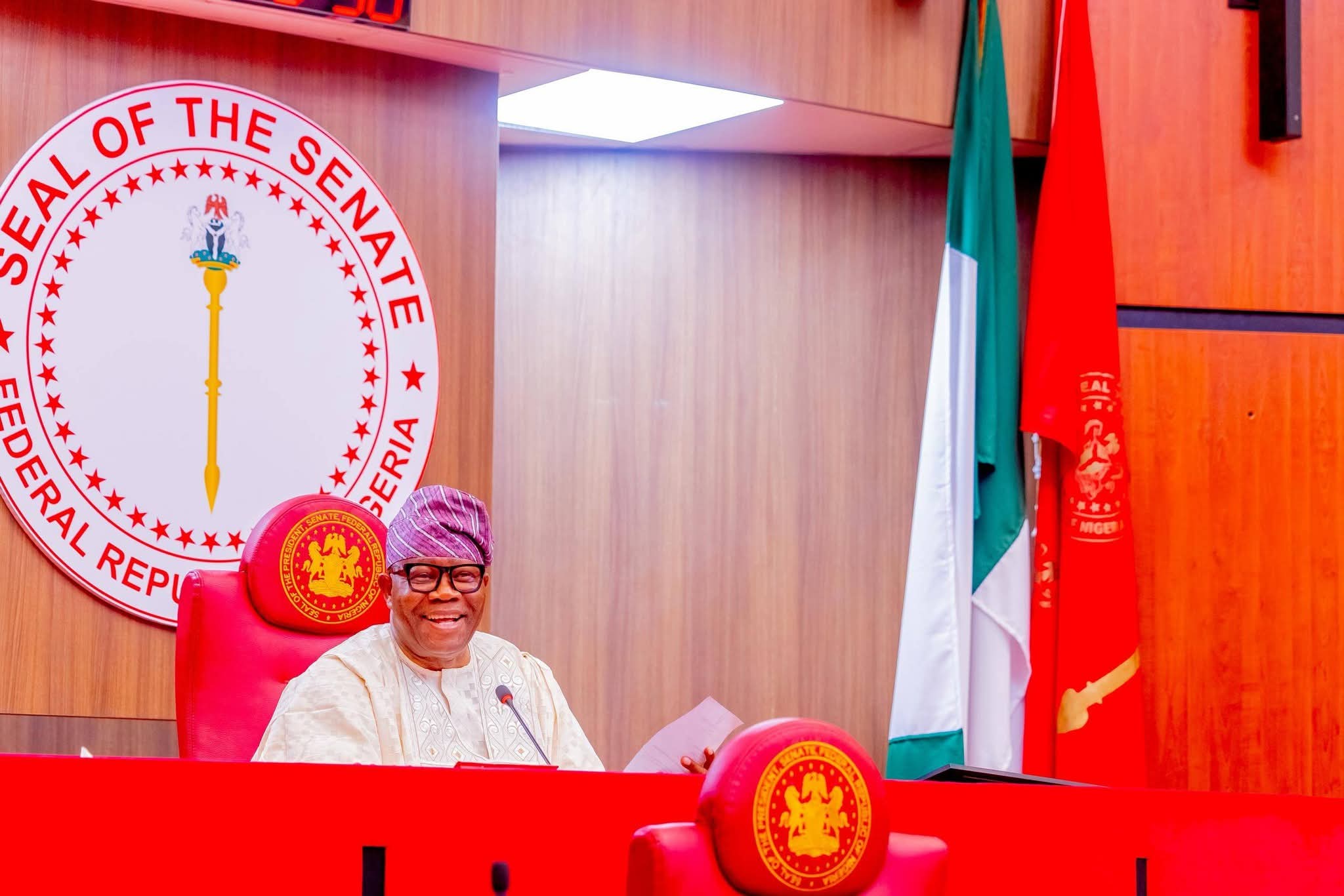
The sweeping changes, adopted after a closed-door session that lasted about three hours, restrict eligibility for presiding offices in the 11th National Assembly to ranking members of the current 10th Senate who win re-election in 2027, effectively shutting out first-time entrants and returning politicians outside the present Assembly.
Presiding offices in the Senate are the President of the Senate and the Deputy President of the Senate, while principal offices include Senate Leader, Deputy Senate Leader, Chief Whip and Deputy Whip of the Senate.
Others are Minority Leader, Deputy Minority Leader, Minority Whip and Deputy Minority Whip.
Rising from the session, senators amended Orders 4 and 5 of the Standing Rules to provide that only those who served consecutively in the 9th and current 10th Senate would qualify for leadership positions in the Red Chamber.
This adds to the existing requirement of ranking, which simply means prior service as a senator.
At the heart of the amendment is a new eligibility clause mandating that any senator aspiring to presiding office must have served at least two terms — amounting to eight years — with one of those terms being the immediate preceding tenure in the Senate.
Presenting the amendment during plenary, Deputy Senate Leader Oyelola Ashiru, who stood in for Senate Leader Opeyemi Bamidele, defended the move as a constitutional exercise aimed at strengthening legislative processes and ensuring institutional stability.
Citing Section 60 of the 1999 Constitution (as amended), Ashiru said the Senate has the authority to regulate its internal procedures, including rules guiding leadership selection.
According to him, the review of the Senate Standing Orders 2023 was designed to enhance efficiency, improve clarity in parliamentary processes and align Nigeria’s legislative practices with global standards.
“A Senator shall not be eligible to contest as a Presiding Officer unless he has been elected and served as a Senator for at least two terms of eight years, one term of which shall immediately precede such election,” Ashiru declared.
He added that the changes would establish a clear ranking framework consistent with parliamentary conventions worldwide, ensuring that only experienced lawmakers occupy leadership positions.
The amended Order 4 states: “Nomination of Senators to serve as Presiding Officers shall be in accordance with the ranking of Senators and shall be strictly adhered to.
“The order of ranking are (i) Former President of the Senate, (ii) Former Deputy President of the Senate, (iii) Former Principal Officers of the Senate, (iv) Senators who had served at least one term of four years, (v) Senators who had been members of the House of Representatives, (vi) In the absence of i to v, Senators elected into the Senate for the first time.”
It went further with an additional provision in Order 5 to prune the field of aspirants for top Senate positions.
The order states: “Any Senator shall not be eligible to contest for any Principal Office of the Senate unless he has served as a Senator for at least two consecutive terms immediately preceding nomination,” thereby excluding senators who were not in the 9th and current 10th Senate from contesting presiding officer positions in the 11th Senate.
Beyond leadership eligibility, the revised rules stipulate that only sworn-in senators can participate in proceedings, including voting during the election of presiding officers.
The amendments also address structural reforms within the Senate, including clearer timelines for swearing in absent senators-elect, revised sitting schedules to boost legislative productivity and stricter disciplinary measures for erring lawmakers.
In addition, the Senate moved to strengthen committee operations by ensuring equitable representation across the six geopolitical zones and harmonising committee jurisdictions with those of the House of Representatives.
Ashiru explained that the updated rules formally recognise several newly established committees considered vital to national development, including those focusing on livestock development, regional development commissions and reparations.
“These committees are critical to strengthening legislative oversight, development frameworks, regional intervention agencies and socio-economic justice initiatives,” he said.
He warned that failure to update the Standing Orders would weaken the Senate’s institutional capacity, create procedural uncertainty and hinder effective oversight.
“Convinced that the proposed amendments will promote procedural certainty, enhance inclusiveness, strengthen oversight functions and align the Senate with global best parliamentary practices, the Senate should resolve into the Committee of the Whole to consider and approve the amendments,” he added.


